The walls go up as seven panels on seven posts. The dome rides on wheels around the top of that ring, so the ring has to be round — and separately, roughly centered on the pier.
Those two requirements deserve very different amounts of effort.
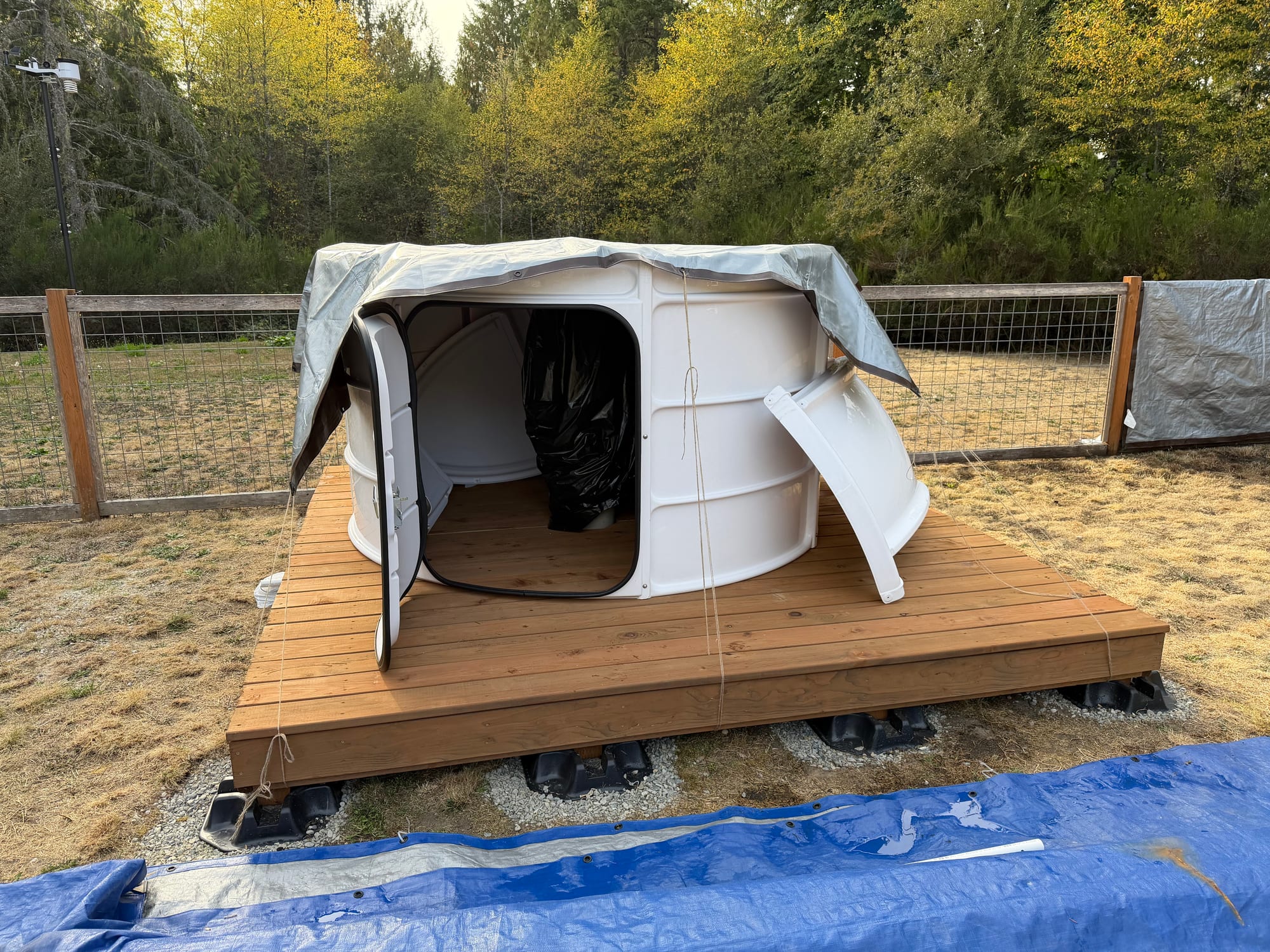
The method that did not work
The first approach was a trammel: pin a batten at the pier center, swing it, and check the radius at every post. Equal radii prove round and centered in one pass.
It does not work here. The center point is inside the pier — there is concrete occupying it, so no pivot can go there.
The second attempt measured from the pier's surface to each post, sweeping the tape for a minimum reading. That is geometrically sound but produced a 1″ spread after many passes.
The problem was the datum. A concrete pier formed in a cardboard tube is not a precision surface — a spiral seam, minor bulges, and surface texture can account for ±¼″ on their own. The ring was fine; the reference was not.
What worked: measure the ring against itself
Take the pier out of it entirely and measure post face to post face:
- Seven adjacent chords — post to the next post, about 38½″ each
- Seven skip-one chords — post to the next-but-one, about 69¼″ each
Both sets are needed. Equal adjacent chords alone do not prove a circle — a seven-sided figure can have equal sides and still be squashed. The skip-one set locks it down.
The absolute numbers do not matter. The spread does. If every reading in a set agrees with the others within about ⅛″, the ring is round, whatever the nominal figure.
The radius itself comes from the ring, not from a catalog: wrap a tape around the outside and divide by 6.2832. This build measured 278.5″ of circumference → 44.32″ radius, which cross-checks against the published 88″ ring diameter.
Source NexDome — NexDome 2.2m (8') Complete Observatory, product page — https://www.nexdome.com/nexdome-2-2m-8-complete-observatory
Plumb matters as much as round
The chords get measured at the base. The dome rides on the ring 53″ up. Those are only the same circle if the walls are vertical.
Plumb every post, two faces 90° apart. A post that leans lets the base read perfect while the top sits an inch out — and the dome will report it every night.
Centering barely matters
Round needs precision because the dome's wheels ride the ring; out-of-round means binding.
Centering does not. Half an inch of offset between the dome's center and the telescope is about 1% of the dome radius, and the slit is far wider than that. It will never show up in use.
Holding the loose requirement to the tight requirement's standard is what makes this step feel like a fight.
Priority order: chords equal → posts plumb → ring level → door swings freely → centered within ½″.
Reading the pattern before pushing anything
Compare roughly opposite posts:
- Opposite posts differ from each other → the ring is round but sitting off-center. Do not deform anything; slide the whole assembly toward the short side by half the difference. One move fixes every reading.
- Opposite posts match but differ from other pairs → the ring is centered but pulled into an oval. That is when you push and pull at posts.
The ring is a closed loop with fixed circumference. Push in on the long axis and the short axis pushes out — so work opposite pairs, not one post at a time, and expect two or three rounds.
Mark each post's position on the deck before starting, and check the door still swings freely after every round. Door openings distort more than anywhere else.
Let the dome do the final check
Snug the brackets, do not torque them, until the dome is on and turning.
The dome is a far more sensitive gauge than any tape. Rotate it slowly by hand, several full turns, before powering anything — you want to feel resistance, not hear it fail. The pattern tells you what is wrong:
| Symptom | Cause |
|---|---|
| Binds at one spot each revolution | Local high or tight spot — mark where on the ring |
| Binds at the same compass direction | The ring, not the dome |
| A wheel lifts off the track | Ring not level there, or a post settled — shim |
| Heavy through half the turn | Ring tilted, dome rolling downhill |
Once the roof is on, the ring is loaded and held in the dome's shape. Moving a post then fights ~250 lb of dome and can force a bind somewhere else. Small moves, one at a time, and rotate between each rather than measure between each.
Wheels that do not touch
Two wheels not contacting the dome, roughly 180° apart, is the signature of a slight oval rather than a local defect. If both sit between posts, mid-panel bow is the other candidate — panels are least stiff at mid-span.
One test separates them: mark the ring at each gap and the dome skirt directly above, rotate the dome 180°, and look again. Gap stays with the ring → it is the wall. Gap moves with the dome → the dome is slightly out of round.
Shim the wheel bracket rather than move the wall. If rotation is already smooth with light effort, that is the outcome you were chasing. Pushing a panel to close a ⅛″ gap risks trading a harmless gap for a bind, on a ring now loaded with 250 pounds of dome.
And check the instructions first: some dome designs have load wheels and guide wheels, and guides are not meant to bear continuously.